
The Field in Between
Agata Mickiewicz & Styrmir Örn Guðmundsson
Gallery 2
7th of February – 23rd of August 2026
Styrmir Örn Guðmundsson and Agata Mickiewicz: The Field in Between
The attributes of liminality or of liminal personae (“threshold people”) are necessarily ambiguous since this condition and these persons elude or slip through the network of classifications that normally locate states and positions in cultural space. Liminal entities are neither here nor there; they are betwixt and between the positions assigned and arranged by law, custom, convention, and ceremonial. As such, their ambiguous and indeterminate attributes are expressed by a rich variety of symbols in many societies that ritualise social and cultural transitions. Thus, liminality is frequently likened to death, to being in the womb, to invisibility, to darkness, to bisexuality, to the wilderness, and to an eclipse of the sun or moon.
– Victor Turner, The Ritual Process1
Energy, joy, and the creative act are central to the works of multi-disciplinary artists Styrmir and Agata. In their exhibition, The Field in Between, they produce works that relate to one another and to ways of being-in-the-field: in this case, the landscape. Each artist tackles modes of being-in-space in divergent ways: Styrmir offers viewers video of himself inline skating in the Icelandic landscape, a kinetic corporeal mode, and Agata provides a sculptural installation made from wool and red glass that dramatically alters the space and invites spectators to sit down, meditate, and turn inwards: a transcendent, psychological or spiritual mode.
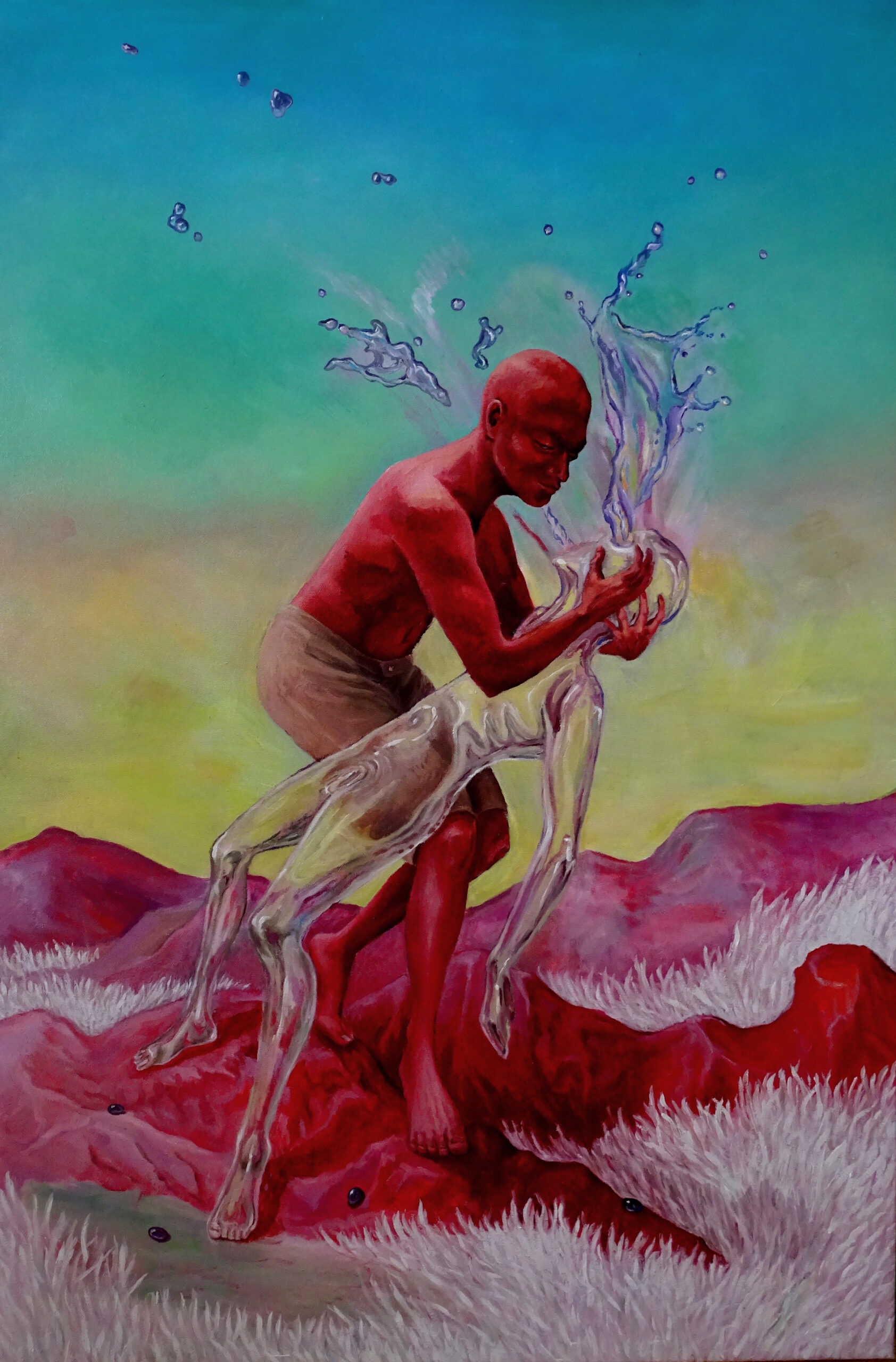
Additionally, both artists install their visions of landscapes inspired by the fields between mountains in Iceland. Agata has a triptych titled “The Field in Between.” It is an allegorical oil on canvas painting that represents both the three dimensions that humans live in and the three modes of time—past, present, and future—that humans inhabit psychologically. This large, surreal canvas for viewers to contemplate has two deities that represent the transience of matter, and it has a hovering red crystal rock in the central canvas that represents a geometry of elementary energy. Styrmir exhibits a fantasy landscape inspired by the mountains of Reykjadalur; his bold and expressive color palette is evocative of street art, graffiti and the Fauvists.
Agata has a background in textile arts and is interested in geomantic energies: for instance, the Schumann resonance (global electromagnetic frequencies, generated and excited by lightning).2
She is inspired by physics and crystal lattice structures: specifically, the ways that atoms of elements organize themselves into patterns. Thus, glass and fabric, materials that can embody the properties of patterns and hardness, are the current materials that her works are made from. Agata is also drawn to the folk traditions and folklore of Iceland. She chooses natural materials like wool, glass and crystals and does not alter their energies. In her own words: “I love a contrast match of softness of textiles and hardness of crystal rock or glass. also love the process of painting. I create an image by turning myself into (a) subconscious state and turning off a ‘critical’ mind.”3
Intuition and a reliance on it are important for both her process as well as Styrmir’s.
Styrmir draws variegated inspirations from cave paintings, murals, comic books, the expressionist Johannes Kjarval (1885-1972), lyrical conceptual artist Hreinn Friðfinnsson (1943-2024), pop artists like David Hockney (1937-), Lithuanian symbolist painter and composer Čiurlionis (1875-1911), artists of the relational aesthetics generation, like Walid Raad (1967-) and the Atlas Group, and Francis Alÿs (1959-). It follows that the work of Styrmir operates, albeit subtly, in ways that are tangential to and bear traces and relations to all the above-mentioned people. For example, the combination of a static mural of constellations of stars fused with the social relational aspects contributed by rock-climbing grips affixed to a wall of a public commission Styrmir made in Grandi, Reykjavik, is a piece that invites participation. Viewers can climb on a mural of constellations painted on the side of a building, becoming participants in an artwork of relational aesthetics, kinetically activating the piece by using it as a climbing wall. The physical activity is then a potential mode for participants to experience and complete the work of the artist.
In the dedicated choice of Styrmir and Agata to work with multiple artistic forms and mediums, these artists could be seen as liminal personae, the “threshold people” that Victor Turner describes, because their work slips and exceeds the normal categories that are imposed or self-imposed on artists by the networks of cultural space. This character of slippage and shifting due to multiple media makes for works that are generous, richly symbolic and ambiguous all at once. It is apt that, as “threshold people,” Styrmir and Agata choose the title of “The Field in Between” for their exhibition in LÁ Art museum Hveragerði, because the in-betweenness that they are exploring in both the physical and psychic landscape by means of “energy work” is reflected in their choice to exhibit together with reciprocal and inverted artistic positions: Styrmir by showing an expressive landscape, and himself as an active embodied agent within the field of that landscape, and Agata by also showing an allegorical landscape, representative of energy and time, and providing a space within her installation for people to turn inwards, reflect, and inhabit their own energetic field within the specific spatial-temporal location of Hveragerði.
Both artists—who have lived and worked in Amsterdam in the Netherlands, Warsaw in Poland, Berlin in Germany, and Reykjavik in Iceland—are drawn to ways of working with art that are exploratory, process-driven and bridge between mediums and formats: video, painting, drawing, music and performance. For Styrmir, words that encapsulate his work are: joy, surprise and open windows. The first two are his intrinsic motivations for working as an artist, and the third is what art does for oneself and for society: expanding it.4
Art is also one of the cornerstones of what anthropologist Victor Turner would call communitas: common places or causes, at times short-lived, where people can gather together without a hierarchical social structure.5
Agata sums up her work with the following: idealism, evolution, transcendence. These are words with which she frames her artistic practice and philosophy. They are, in a way, more introspective terms: the first word, a belief or standard one holds; the second, the telos or drive of life; and the last word describes a process and ultimately a goal of superseding, climbing beyond—towards spiritual realms—that are universal.
In The Field In Between, Styrmir Örn Guðmundsson and Agata Mickiewicz provide complementary artistic positions about Iceland from the vantage point of “threshold people” artists working with a variety of materials and mediums, resisting easy categorization. People who themselves are “betwixt and between.” 6
They explore and invite viewers to approach their work, and the land that informs it, with joy, energetically to reflect, meditate, evolve and transcend.
Text by Dr. Craniv Boyd.
1) Victor Turner, The Ritual Process: Structure and Anti-Structure, (Ithaca: Cornell University Press, 1969), p. 95.
2) For more on Schumann resonance, see https://en.wikipedia.org/wiki/Schumann_resonances.
3) Email correspondance with Agata Mickiewicz, October 17, 2025.
4) Email correspondance with Styrmir Orn, October 17, 2025.
5) For definitions of communitas and several cross-cultural and historical examples, see chapter 4, “Communitas: Model and Process” in Turner, 1969.
6) See Turner, 1969, p. 95.