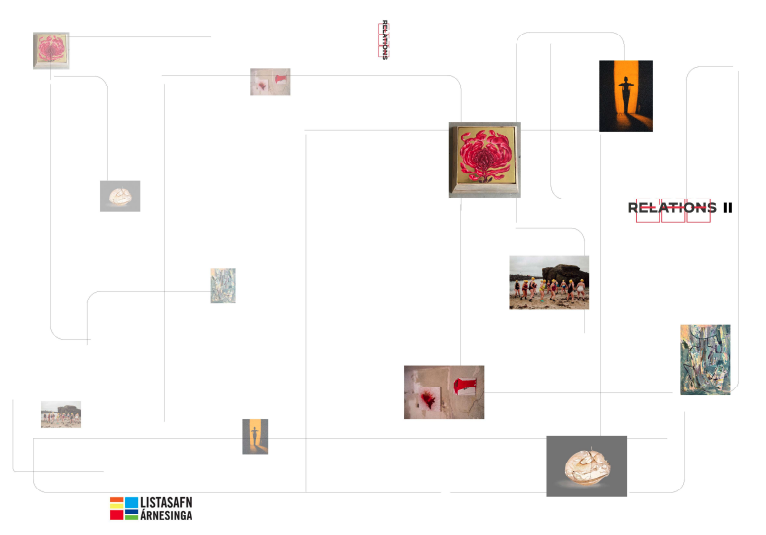



RELATIONS II Female
Kristín Gunnlaugsdóttir, Sigríður Rut Marrow, Hulda Vilhjálmsdóttir, Birgit Graschopf, Tanja Prušnik, Ramona Schnekenburger.
Gallery 1
12th of September – 23rd of December 2026
Curator: Tanja Prušnik
RELATIONS II Female – bridge over ocean and continent – Bridging Cultures, Shaping Narratives
The works of Birgit Graschopf, Kristín Gunnlaugsdóttir, Sigríður Rut Marrow, Tanja Prušnik, Ramona Schnekenburger, and Hulda Vilhjálmsdóttir are connected through a particular sensitivity to the in-between, to those quiet transitions between body and landscape, memory and presence, visibility and inner experience. Their works do not emerge from a desire to depict reality, but from the need to make atmospheric states visible and physically tangible, and to create relationships between one another. One work seems to grow out of another; connections become visible, even though the works were not created in direct dialogue.
Within the exhibition, material becomes a carrier of memory and touch: concrete, sandpaper, fish skin, textile fragments, paint, water, and paper preserve traces of time, movement, and lived experience. The artists work in open, process-oriented, and often intuitive ways. Their works develop through layers, condensations, and transformations, like landscapes slowly changing, or memories that can never be fully grasped. Iceland and Austria, two geographically distant yet artistically connected places, play an important role as mediating landscapes within these artistically and partly feminist-oriented practices.
Again and again, the female body appears at the center, not as representation, but as a sensitive space of perception, vulnerability, strength, and connection. Nature is not treated as a background, but as a living presence inscribed into gestures, materials, and movements. The sea, waterfalls, Icelandic landscapes, and organic forms become resonant spaces for inner emotional states.
Through the juxtaposition of these artistic positions, a poetic dialogue emerges about closeness, transformation, and belonging. Despite their different media and visual languages, all of the works share a quiet intensity and a search for forms of expression beyond the explicit. Their works open spaces for the unspoken, fragile and open visual worlds in which memory, body, and landscape enter into relation with one another.
……………………………………………………………………………………………………………………………………..
About the Artists’ Work, Tanja Prušnik:
Birgit Graschopf develops photographic works that move between visibility and withdrawal. Architecture, body, and space enter into a tense relationship in which the photographic image loses its apparent clarity. Her works emerge through a multilayered process of transformation: digital images are transferred back into analogue processes, applied onto unusual surfaces, and materially condensed. Concrete, sandpaper, or wall surfaces function not merely as supports, but as active carriers of time and traces.
The surfaces appear both fragile and resistant, soft and abrasive. Graschopf explores not only the conditions of photographic perception, but also the psychological and social inscriptions of space. Her works create an oscillating structure between presence and illusion, between physical materiality and immaterial memory. Sandpaper purchased in Iceland becomes part of a personal investigation through the transfer of non-Icelandic motifs onto Icelandic material.
Ramona Schnekenburger approaches the relationship between human, animal, and nature from a poetic and transformative perspective. Her pictorial spaces and objects unfold through organic transitions in which fixed categories lose their boundaries. Hybrid beings, fragile skins, bone-like forms, and embryonic structures appear not as alien creatures, but as possibilities for new forms of connection.
The artist works through slow and layered processes of drawing, painting, scratching, and shaping. Materials play an essential role in the emotional and conceptual charge of the work: fish skin, ash, paper, and canvas preserve traces of vulnerability, transformation, and intimacy. Schnekenburger’s works speak of transitions between interior and exterior, the human and the non-human, memory and future. In their quiet intensity, they develop a unique corporeality, delicate, archaic, and at the same time deeply present. Integrating Iceland itself into the work, its magical stories, the harshness of life, and the tenderness of its mysterious narratives, forms an essential part of Schnekenburger’s artistic process on site. New objects emerge in situ from Icelandic fish skins, becoming new experiences for the artist herself.
Tanja Prušnik also understands painting as an open process of condensation and translation. The starting points of her works are perceptions of landscape, architecture, movement, and socio-feminist concerns, which do not remain visible as motifs but are transformed into color, rhythm, and structure. Her pictorial spaces arise from gestural marks, overlapping color fields, and the tension between emptiness and density. Color becomes a spatial event that simultaneously creates surface and depth.
The works possess an immediate physical presence while maintaining a poetic openness that allows associations without fixing them. Particularly characteristic is the artist’s serial way of working: paintings stand in relation to one another, react to each other, and develop their own dynamics within space. The boundary between painting, object, and installation increasingly dissolves. Prušnik’s works are less concerned with depicting the world than with making perception itself visible, as movement, atmospheric layering, and a sensitive balance between control and openness.
Sigríður Rut Marrow’s photographic gaze is directed toward the Icelandic population itself. Her documentary-poetic photo and video series follows women who have found in the sea a place for community, bodily awareness, and inner strength. At the same time, the project reveals how important simple rituals can be for emotional balance.
Throughout all seasons, the women meet at coastlines, lakes, and open water sites to enter the cold sea together. The images and filmic scenes focus less on the act of swimming itself than on the feeling of togetherness shaping these moments. In the water and along the shore, everyday life recedes; conversations become quieter, movements freer. Many women describe immersion in the sea as a pause from constant functioning, a moment in which only breath, cold, and nature remain.
The project unfolds throughout the country in sun, snow, and storms. It observes quiet yet powerful moments: women supporting one another, laughing, or floating silently side by side. Differences such as age, profession, or background lose significance, what remains essential is the shared experience.
Kristín Gunnlaugsdóttir’s work is characterized by a consistent openness in her use of material, form, and visual language. Again and again, she breaks apart familiar visual structures, recombines fragments, and develops from them a multilayered artistic language of her own. Between figuration and free abstraction, works emerge that resist fixed categorization and gain a particular intensity precisely through this openness.
Drawing from traditional imagery, religious symbolism, and icon painting, Kristín early on developed a visual language in which the human being, especially the female body, becomes a carrier of inner states. Her works do not narrate linearly, but through suggestion, signs, and emotional spaces. Fabrics, lines, colors, and surfaces function like memories or traces of lived experience.
Hulda Vilhjálmsdóttir’s artistic work is deeply connected to the Icelandic landscape and emotional memory. Growing up in close proximity to nature, she developed an early sensitivity for the relationship between human beings, landscape, and inner experience. Women, mountains, the sea, and shifting light continue to shape her visual language today.
Through natural forms and movements, Hulda began recognizing human conditions within nature itself, especially tensions between strength and vulnerability that are also reflected in female figures. Her works present less concrete portraits than emotional states: memory, longing, closeness, and solitude become perceptible through atmosphere, color, and corporeality.
Her painting moves between landscape and body, between visibility and emotion. Her female figures often seem part of the Icelandic earth itself, calm, powerful, and filled with presence. Femininity appears here as an expression of inner strength, dignity, and closeness. In contrast, her free abstract visual language is shaped by movement, rhythm, and a meditative working process. Inspired by Asian painting and the slow movements of the sea, she creates reduced and poetic works full of openness and quiet depth.