True / untrue
Halldór Ragnarsson
Gallery 3
12th of September – 23rd of December 2026
True/False Halldór Ragnarsson
Perhaps more so than at any other time in history, the lines between truth and fiction and their representations are blurred. Younger generations now assess the photographic image with the added lens of deciphering if it is made with artificial intelligence or not, whereas previous generations viewed the world with the conviction that photographs were proof of reality, an extension of the lens that the proof is in seeing with the eyes. There exists a long tradition of asemic writing, or illegible, abstract marks that resemble writing but lack specific semantic meaning. It acts as a writing without language, a kind of participation in mimicking the signs in its own interpretation, telling a truth in its own language.
Somewhere between these poles exists Halldór Ragnarsson’s investigation of the representation of truth and falsehood in the current moment. Or at least, an investigation conducted from the inside: testing the limits of one’s own grounded knowledge, and finding those limits closer than expected.
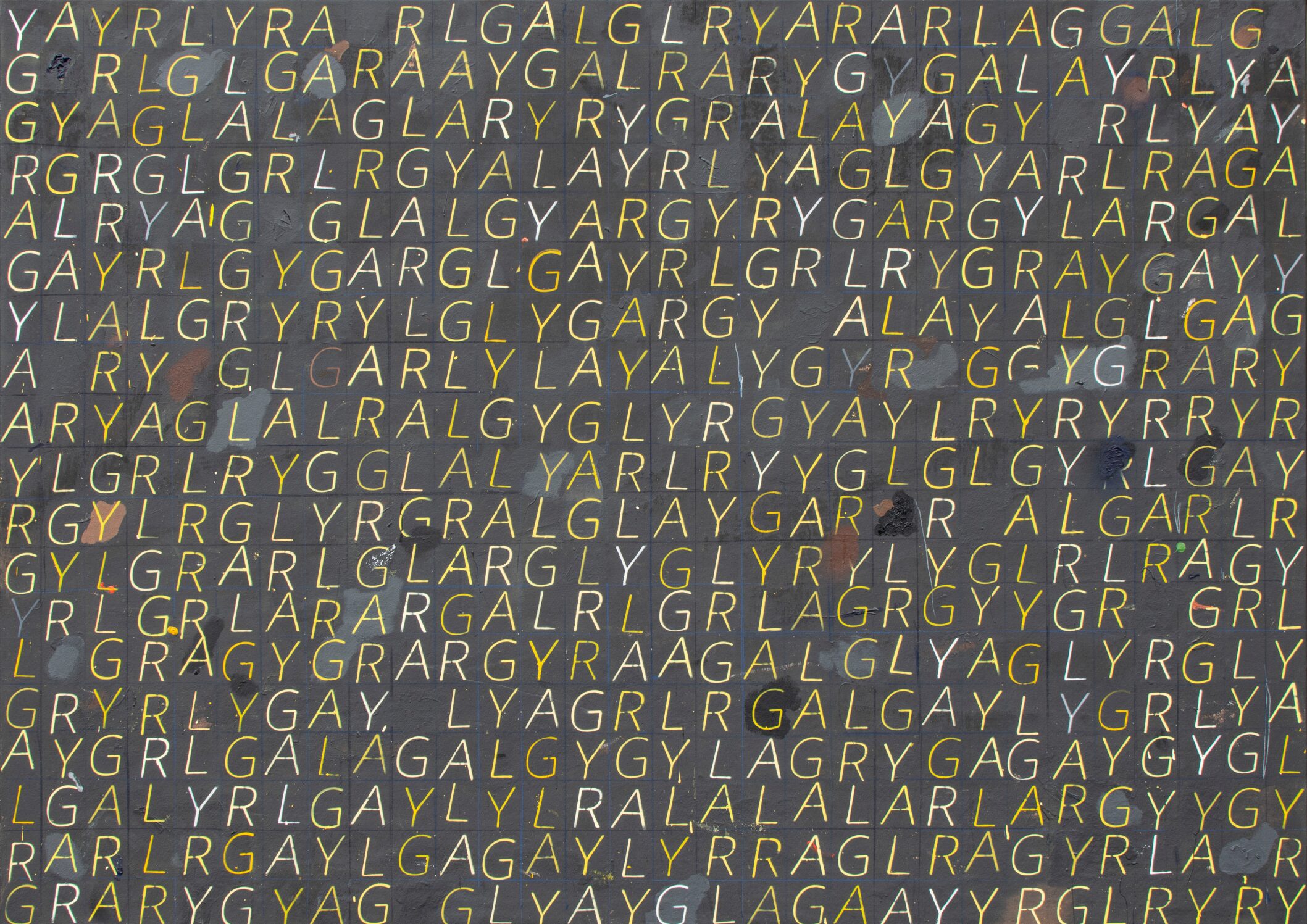
Halldór Ragnarsson is taking this assessment to the representation of language. After all, language is an image of a set of signs with a shared meaning. The Reykjavík-based painter explores the relationship between language and painting using words and short phrases as primary material — mostly derived from his diary — as a cadre of reflections on the testing of perceived reality against an embodied senses. Ragnarsson integrates text directly into the surface of the canvas, allowing language to function also as image.
Repetition plays a central role in his process. Through the repeated writing and layering of words, language gradually shifts from communication toward rhythm, texture, and visual form — the word worn down like a stone in a river until what remains is more sensation than sign. This is not erasure exactly, but a kind of pressure: the same word written ten times, twenty times, until the reader is no longer sure whether they are reading or simply looking. At a certain threshold of repetition, meaning does not disappear so much as it loosens, begins to float free of its referent, and something else moves in to take its place — something closer to feeling, or to the physical fact of the mark itself.
The works often move between sincerity and ambiguity, examining how emotional meaning can emerge, dissolve, or transform through repetition. A word written once is a statement. Written many times it becomes a question, an incantation, a doubt, a texture. Ragnarsson’s paintings investigate the fragile boundary between reading and seeing — where language becomes both a visual structure and a psychological space — asking how much of meaning lives in the word itself, and how much is simply the residue of attention.
The poet and critic Cole Swenson writes on Cy Twombly, another artist who investigated the painting of language and its altered meaning as image:
“Illegible writing shows things to be what they are not. That is why it is “sanctioned” by whatever means possible (by various authorities, from school on). It is accused of trying to
hide something, of being a disguise. It is “read” (by graphologists and others) as a gesture of refusal, as antisocial. It is at least an indication of the tenuous, fragile nature of this legibility of the most basic kind. It shows the legible to be a category that is forever under threat, forever in danger of disappearing, of becoming lost, despite appearances, in a paradoxical obscurity where writing can be seen and recognized, but can no longer be read. Illegible writing indicates in fact that the sign has been remorsefully eaten away by its own figurative nature, and that it does indeed take almost nothing at all for the figure to resort back to its status as a mere drawing.”*
Like Twombly, Ragnarsson departs from cultural and linguistic meaning toward something logically prior to — or in a sense behind — signification. Language in his work is always true the moment it is written or spoken, right up until the point where it must refer to something, and this gestures towards the human body in its pleasing human handwriting, looping and declaring, but also testing out this statement on the world.
The works presented in the exhibition, created over the past year, take up this question of truth and falsehood in the contemporary world. What is real, and who decides? In a world where images, texts, and voices are constantly being reproduced by people and machines alike, reality may simply become whichever purported truth one gives their attention to.
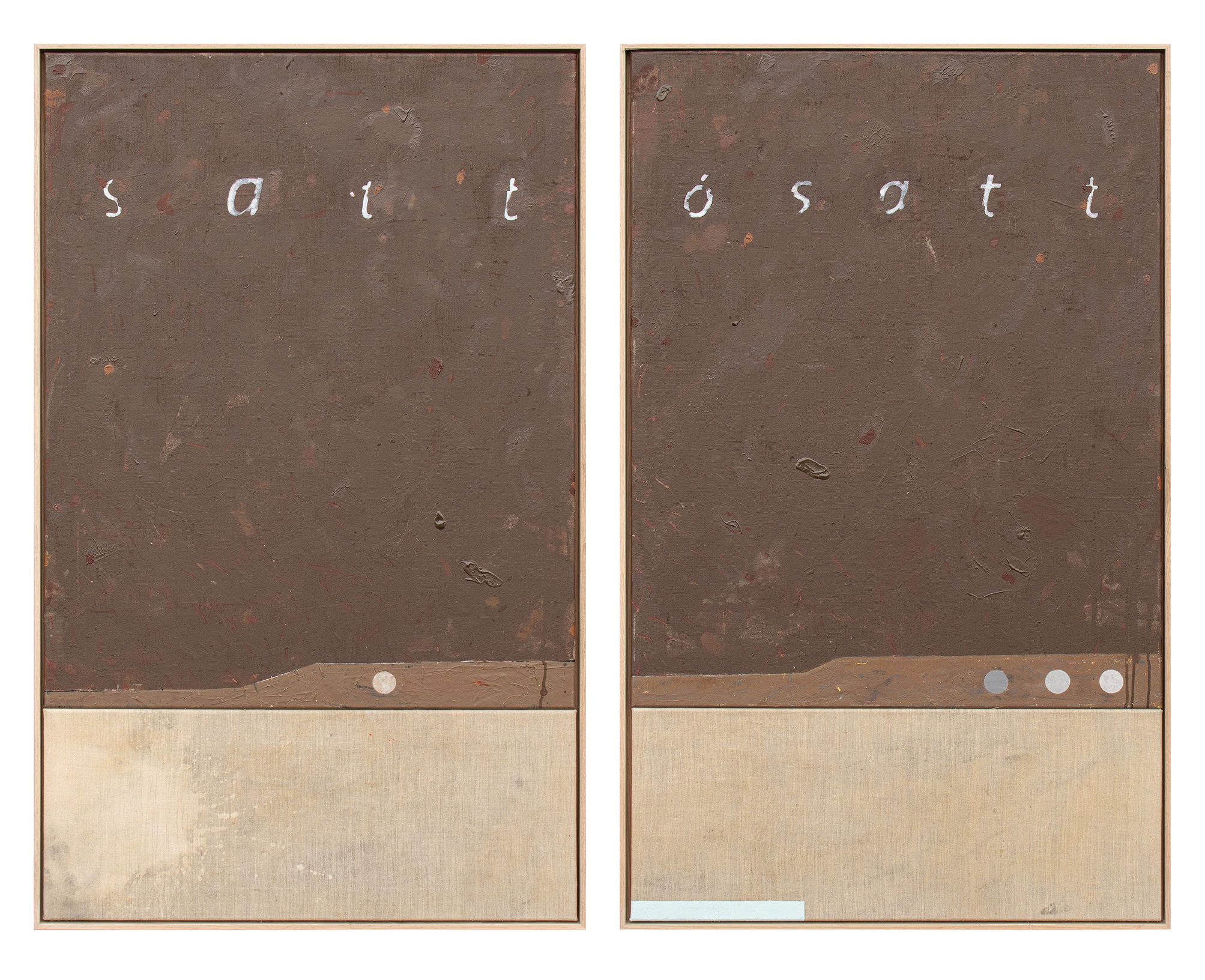
The titles of the works are statements in themselves, setting the tone for a declaration made at the world as though testing its viability in a material reality outside of oneself. Words and sentences appear again and again, sometimes until they lose meaning, sometimes until they become entrenched as truth. In this process, language becomes both a material and a method — a tool for approaching something that may not be directly possible to say. Everyone performs a version of themselves — polished, desirable, unattainable. The distance between what is shown and what is real has never felt greater, or more invisible.
The exhibition is not only about external realities such as artificial intelligence or social media, but also about personal experience. When do I tell the truth? When do I change the narrative? And for whom? Are you existing, or showing that you exist? Every lie, after all, is told to make you look better — or at least to not make you look worse. Truth often seems to depend on context, intention, and recipient, and the philosophers Ragnarsson has been sitting with — Baudrillard’s hyperreality, Wittgenstein’s limits of language and world — offer less a resolution than a confirmation of the problem. The works are filled with contradictions: statements that deny themselves, sentences that seem clear but open up upon closer inspection. There is a gap between what is said and what is meant — and perhaps that gap is precisely the space where something real can flow through, messy, unpolished, attempting legibility. Can we translate the knowledge that material gives us into language? What would it say?
*SWENSEN, Cole. “A Hand Writing.” Noise That Stays Noise: Essays. Ann Arbor: University of Michigan Press, 2011: 82-89.
Text by Erin Honeycutt