
The Golden Circle
Weronika Balcerak & Lukas Bury
Gallery 2
12th of September – 23rd of December 2026
The Golden Circle
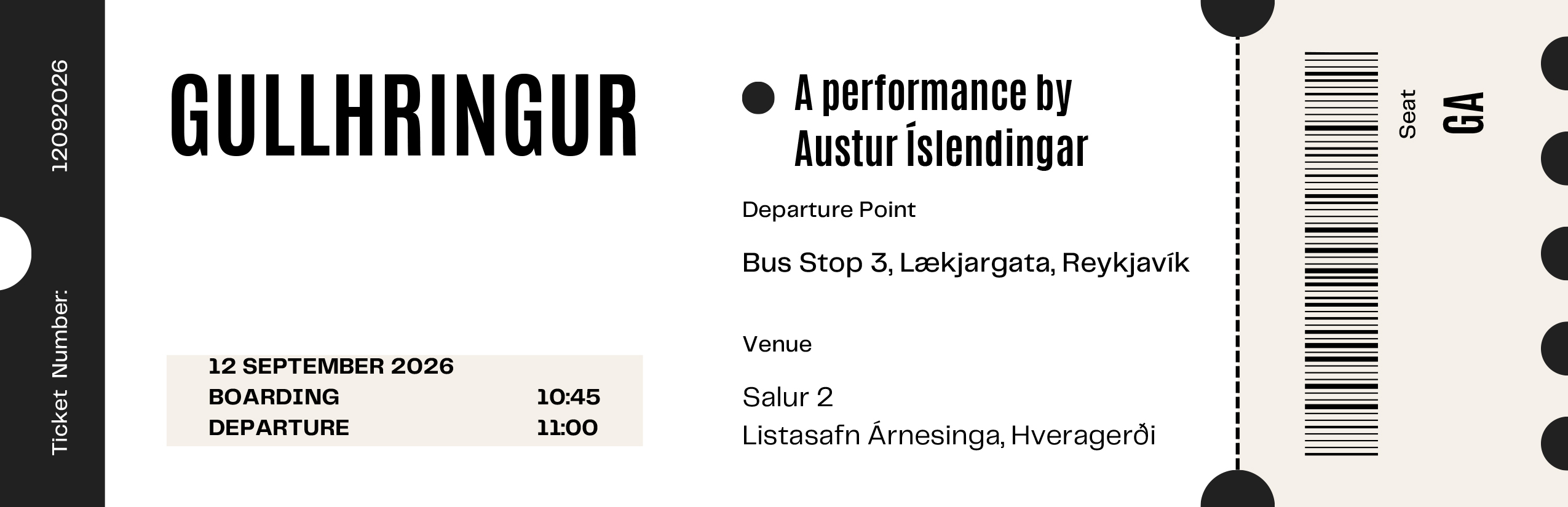
Part performance, part video art, part documentary, the artist duo Austur-Íslendingar (East Icelanders) — Weronika Balcerak and Lukas Bury — board a tour bus on the Golden Circle route with Icelanders as their audience. The bus follows the standard itinerary: Þingvellir, Geysir, Gullfoss. Three sites at the centre of Iceland’s self-image, so thoroughly mediated by the tourism industry that to visit them is already to see them twice — once in the flesh, once through the image that preceded the visit. The landscape is both within and in front of us. It has been made before we arrive at it.
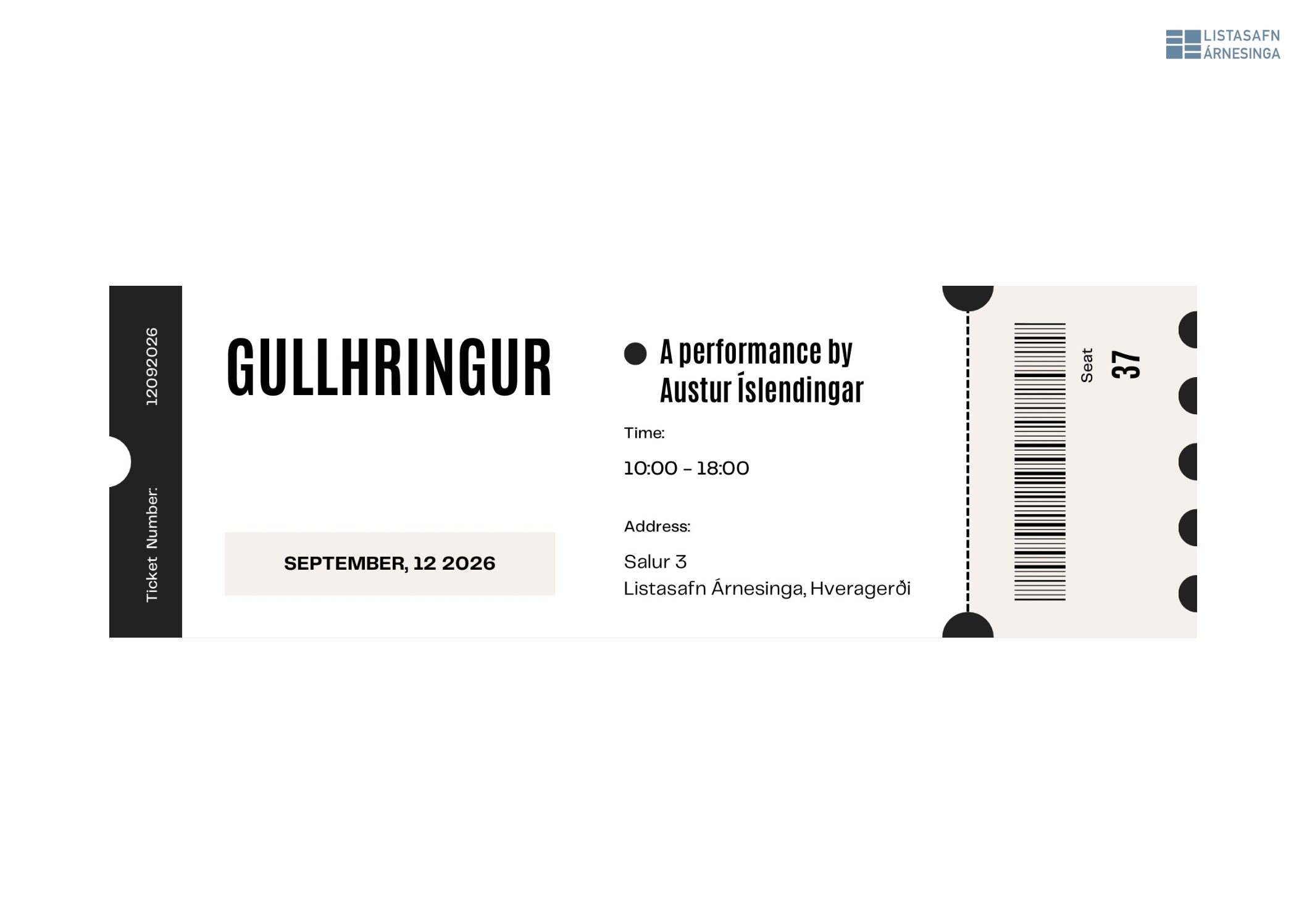
The performance of a hired tour guide is livestreamed to the LÁ Art Museum. The bus ends its route there, where guides and passengers step off together and the two audiences — those who travelled and those who watched — finally meet. The footage becomes the exhibition.
The livestream introduces a third kind of knowing. Those seated in the LÁ Art Museum watch the Golden Circle as it is happening, in real time, on a screen — which is also how most of them first encountered it. The delay is not technical but ontological: to watch a landscape unfold through a camera is to be present to it and absent from it simultaneously, a condition that feels new but is not. It is the condition of all mediated experience, made suddenly legible by the frame. Walter Benjamin wrote that mechanical reproduction strips the original of its aura — its presence in time and space — but what the livestream proposes is something more unsettling: that the aura was always partly constructed, that the original was always already a version. The witness in the museum is not receiving a lesser experience than the passenger on the bus. They are receiving a different one, with a different set of exclusions. The passenger cannot step outside the script; the witness cannot feel the splatter at Gullfoss. Neither has unmediated access to the place. What the distance of the screen makes visible is what proximity conceals: that to be a spectator of landscape — any landscape, including one you grew up beside — is always to arrive a little late, to inherit an image already in circulation, to experience the moment and its representation as inseparable. The livestream does not diminish the journey but names what the journey always was, revealed to us through the vision of Austur-Íslendingar.
Austur-Íslendingar takes its name from Vestur-Íslendingar — the historical term for Icelanders who emigrated to America — inverting the direction of displacement. Balcerak and Bury are both Polish-born, both based in Reykjavík, both working in a tourism industry in which the majority of guides are not Icelandic themselves. Their work asks what it means to become a custodian of a national story that belongs, at least in principle, to the passengers on this particular bus. The guided tour is a form with its own conventions: a body at the front of a moving vehicle, a script rehearsed into something that sounds spontaneous, facts whose selection is never neutral. Landscape, as phenomenology insists, is largely constructed of projections — our unexamined longings, desires, prior images — and nowhere is that construction more legible than in the managed itinerary, the approved viewpoint, the caption that tells you what you are seeing.
That reversal is the performance’s central provocation. The Icelanders seated behind the guides know Þingvellir — or believe they do. They may know it from childhood visits, from Kjarval’s paintings of its lava fields, from the romantics who made its landscape into a vessel for national feeling. What they are less likely to know is the version that circulates online, in guidebooks, in the script memorized to make it feel hospitable to strangers. Austur-Íslendingar offers them that version. The question the work poses is not merely historical or sociological: it is perceptual. What folklore has been forgotten by Icelanders themselves? What does the tourist image know — or omit — that a resident no longer thinks to ask?
Since 2008, Iceland has negotiated its self-image with considerable deliberateness. Tourism rebuilt an economy after financial collapse, and with it came a landscape thoroughly re-narrated for foreign consumption — layered, curated, sold. The Golden Circle sits at the centre of that image. Þingvellir carries the weight of national foundation: site of the world’s oldest parliament, painted by Þórarinn B. Þorláksson at the turn of the century, returned to again and again by Kjarval as a place where something essential about Iceland might be held still long enough to paint. That painterly impulse — the attempt to arrest a living landscape in representation — is itself an act of narration, never innocent of the cultural perceptions it consolidates. Every map, too, is a perceptual document: its legends, its colorations, its omissions encode a way of seeing, overlaying geography with the analogue of human cognition. The Golden Circle route is, among other things, a layered map of Iceland’s past and present, imagined and projected upon like a screen. A circle drawn in the sand.
The guided tour has always been a contact zone — a structured encounter between those who perform a place and those who consume it, between the version that travels and the version that stays. Tour guides are among the most prominent inhabitants of that threshold. They are pathfinders, animators, communicators; not simply narrators but cultural mediators who demarcate the terms on which encounter is possible. The tourism industry has long dressed this relation as hospitality, as gift, but the economic and social asymmetries underneath that framing are never far from the surface. The tourist gaze, as scholars of tourism have long argued, is not innocent perception: it is shaped by media images, itineraries, and discourses, and it travels with the histories of power that produced it.
By placing an Icelandic audience in the position ordinarily occupied by first-time visitors, Austur-Íslendingar makes that selection visible. The passengers are neither tourists nor simply locals. They are somewhere in between — which is, the artists might suggest, where most people who live with a landscape eventually find themselves. The tourist script does not simplify this relation but reveals it. It shows how experience has been shaped before arrival by the brochure, the ranking, the photograph, the prior visit of someone else.
What Austur-Íslendingar proposes is that estrangement can be a form of care. To hear your landscape described to you, scripted, packaged, offered back, is not necessarily to lose it. It may be to understand, for the first time, how thoroughly it has been constructed on your behalf, and on behalf of others. The two audiences who meet at the LÁ Art Museum are not reconciled so much as held in productive proximity: those who know Þingvellir by heart, and those who know the version of it that travels. Between them, something like a full account of the place becomes briefly possible. Thus, the tour guide becomes a cultural mediator becomes an actor becomes an artist, through medial roles of pathfinder, animator, and communicator.