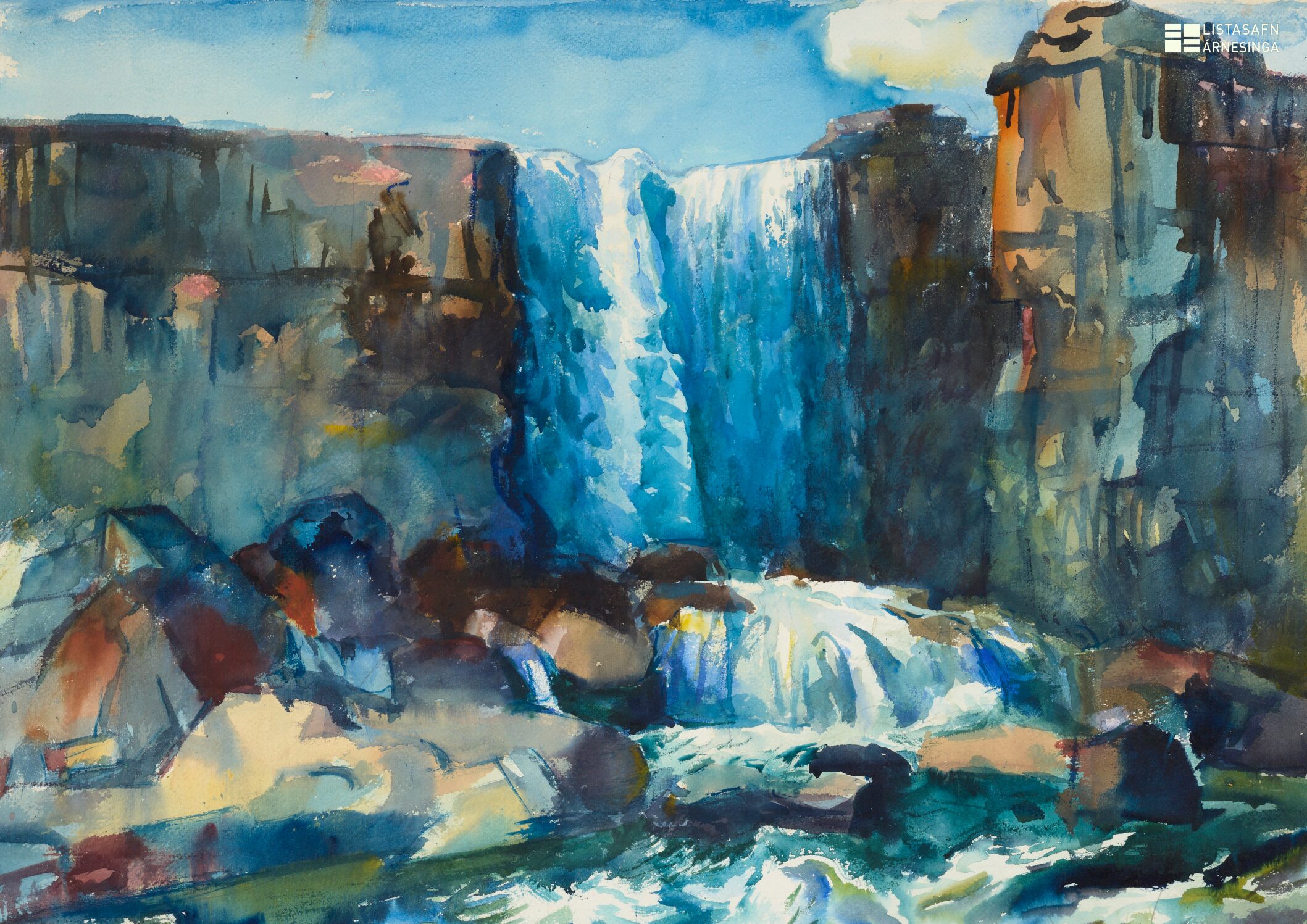


Where the Land Begins
Work from our museum collection.
Gallery 4
12th of September – 31st of May 2027
Where the Land Begins
Our experience of landscape lies at the heart of human existence. We live from the land, within it, and upon it. We perceive it, depend on it, and often regard it with a mixture of awe and respect. At the same time, we shape our surroundings, we alter the landscape, exploit its resources, transform it, and claim space within it. At times we feel small and vulnerable in the face of nature’s immense forces; at others, we place ourselves above the land we inhabit. Yet regardless of where we are in the world, we remain in constant relationship with the land. It surrounds us, always.
The title of the exhibition is taken from a work of the same name in the museum’s collection. It refers not only to the land itself, but also to the moment when nature becomes landscape.
The title of the exhibition Where the land begins is borrowed from a work of the same name in the museum’s collection by the artist Sigrid Valtingojer. Rather than referring solely to the land itself, it invites us to consider the moment when nature becomes landscape.
For generations, the Icelandic landscape has been one of the central subjects of Icelandic art. At first glance, a landscape painting may appear to be nothing more than a representation of a place, a two-dimensional image of a three-dimensional reality. Yet every work of art is shaped by the person who creates it. The artist inevitably leaves something of themselves within the work, and their emotions, memories, and experiences become part of its expression. Likewise, the viewer brings their own experiences and emotions to the encounter. The same mountain, the same lava field, or the same horizon may carry entirely different meanings depending on who is looking. Landscape is therefore created through an ongoing dialogue between nature, the artist, and the viewer.
Where the Land Begins presents a selection of works from the collection of LÁ Art Museum. Today the collection comprises nearly 600 works, ranging from the oldest, created in 1900, to the most recent acquisitions from 2025.
The exhibition traces key moments in the museum’s history while paying tribute to the memory of Bjarnveig Bjarnadóttir and Halldór Einarsson, whose generosity and vision were instrumental in the founding of the museum.
Bjarnveig Bjarnadóttir laid the foundation for Listasafn Árnesinga when, on 19 October 1963, she donated her personal collection of paintings to the people of Árnessýsla. During a formal ceremony at the National Museum of Iceland, she presented forty-one paintings by seventeen artists, all of whom were among Iceland’s leading painters of the time. Bjarnveig believed that people living in rural communities should have the opportunity to experience art, and the museum became the first art museum established outside the Reykjavík capital region. She wished the collection to be accessible to as many people as possible, especially children and hoped that local schools would introduce students to the artworks. Originally housed at Tryggvagata 23 in Selfoss, the museum acquired the former Art pavilion (Listaskálinn) in Hveragerði around the turn of the millennium and opened there in 2001.
Another significant contribution came from the master woodcarver Halldór Einarsson, who, in 1969, donated his entire collection of wood sculptures to the museum together with a monetary gift of $10,000.
Like many Icelanders Halldór Einarsson emigrated to North America due to a combination of devastating natural disasters, severe economic hardship, and social pressures at home, contrasted with the promise of free land abroad.
Icelanders who moved west to North America during the mass migration period of the late 19th and early 20th centuries are called Vestur-Íslendingar, which translates to “Icelanders of the West” or “Western Icelanders”.
Halldór Einarsson grew up at Brandshús in the Flóahreppur municipality in the south of Iceland. He studied woodcarving under Stefán Eiríksson in Reykjavík before emigrating to North America in 1922, where he lived for the next forty-three years. For twenty of those years he resided alone in a cabin in the woods outside Chicago. Throughout his life he devoted himself to carving wood, decorating furniture, and creating wooden sculptures. His artistic subjects ranged widely: alongside woodcarving he also worked in marble and stone, producing sculptures of animals and people, as well as works inspired by religious and spiritual themes, often rich in symbolism. Living in close proximity to the forests and wildlife surrounding his home outside Chicago profoundly influenced his work, and his deep connection to nature is evident throughout his sculptures.
In Where the Land Begins, works by artists such as Ásgrímur Jónsson and Jóhannes S. Kjarval enter into dialogue with more recent works by Icelandic and international artists, alongside selected sculptures by Halldór Einarsson. While the works all engage with nature and landscape, they do so through diverse materials, techniques, colour palettes, and perspectives.
The exhibition invites visitors to reflect on the evolution of landscape painting, the relationship between humanity and nature, our responsibility towards the environment, and the meanings we continue to project onto the landscape.
List of artworks in the exhibiton:
Jóhannes Kjarval, Án heitis / Untitled
Olía á striga / oil on canvas, 124 x 166 cm
Ásta Guðrún Eyvindsdóttir, Hrafninn, 1982
Prent á pappír / print on paper, 71 x 51 cm
Sigrid Valtingojer, Þar sem landið hefst, 1989
Prent á pappír / print on paper, 76 x 100 cm
Bernard Alligand, Tectonique. Retour d’Islande, 2021
Sandur og steinn á pappír / sand and stone on paper, 30 x 30 cm
Ragnheiður Jónsdóttir Ream, Frá Álftanesi, 1975
Olía á striga / oil on canvas, 64 x 69 cm
Bernard Alligand, Tectonique. Retour d’Islande, 2021
Sandur og steinn á pappír / sand and stone on paper, 30 x 30 cm
Bernard Alligand, Tectonique. Retour d’Islande, 2021
Sandur og steinn á pappír / sand and stone on paper, 30 x 30 cm
Sigríður Björnsdóttir, Berðu mig upp til skýja, 1978
Akrýl á striga / acrylic on canvas, 14 x 19 cm
Ásgrímur Jónsson, Keilir á Reykjanesi, 1920
Vatnslitur á pappír / watercolor on paper, 27 x 44cm
Ásgrímur Jónsson, Frá Þingvöllum, Öxarárfoss, 1940
Vatnslitur á pappír / watercolor on paper, 55 x 73 cm
Höskuldur Björnsson, Tveir andarungar
Prent á pappír / print on paper, 12 x 17 cm
Valtýr Pétursson, Landslag, 1987
Olía á striga / oil on canvas, 35 x 35 cm
Torfi Harðarson, Fossinn, 1980
Teikning á pappír / drawing on paper, 72 x 52 cm
Matthías Sigfússon, Öxarárfoss, 1937
Vatnslitur á pappír / watercolor on paper, 41 x 51 cm
Höskuldur Björnsson, Tveir andarungar
Prent á pappír / print on paper, 12 x 17 cm
Mike Vos, Óvænt uppspretta, 2022
Ljósmyndun / photograph, 80 x 60 cm
Gunnlaugur Scheving, Frá Austurlandi
Olía á striga / oil on canvas, 42 x 49 cm
Jóhannes Kjarval, Strandatindur við Seyðisfjörð, 1922
Vatnslitur á pappír / watercolor on paper, 30 x 41 cm
Johann Nepomuk Geller, Frá Þingvöllum
Olía á striga / oil on canvas, 23 x 34 cm
Valtýr Pétursson, Án heitis, 1984
Olía á masonit / oil on hardboard, 81 x 90 cm
Kristján H. Magnússon, Skjaldbreiður, 1933
Olía á striga / oil on canvas, 60 x 78 cm
Gísli Jónsson, Af Hestfjalli
Olía á striga / oil on canvas, 134 x 206 cm
Torfi Harðarson, Á bjargi, 1985
Olía á striga / oil on canvas, 65 x 50 cm
Halldór Einarsson, Grænlenskt sauðnaut
höggmynd úr viði / Carved wooden sculpture
Halldór Einarsson, Alda
beinaskúlptúr / bone sculpture
Halldór Einarsson, Dýr
steinskúlptúr / stone sculpture
Halldór Einarsson, Hestur
Marmarskúlptúr / marble sculpture
Halldór Einarsson , Geirfugl
höggmynd úr viði / Carved wooden sculpture
Halldór Einarsson, Rostungur
Marmarskúlptúr / marble sculpture
Halldór Einarsson, Fiðrildi, 1967
Steinn og marmari / stone and marble sculpture
Halldór Einarsson, The victim
Marmarskúlptúr / marble sculpture
Halldór Einarsson, Hreysikötturinn
Höggmynd úr viði / Carved wooden sculpture
Halldór Einarsson, Fugl
skúlptúr úr beini / bone sculpture
Curator: Alda Rose Cartwright
Research and preparation for exhibition: Alda Rose Cartwright, Anna Karen Skúladóttir & Laurine Cratchley